
Review: Jesus Christ Superstar


For the second summer in a row, the hottest West End ticket belongs to another Tim Rice and Andrew Lloyd Webber rock opera at the London Palladium: Jesus Christ Superstar, following in the flashy footsteps of last summer's Evita—a comparison that becomes impossible to ignore. Starring recording artist and Eurovision finalist Sam Ryder as Jesus, this revival arrived with the promise of stellar vocals, spectacular visuals, and all the makings of a theatrical event. With heaven on its mind, this production certainly aims high—but never quite reaches those heights.
Like many rock operas, Jesus Christ Superstar asks audiences to buy into its style and lends itself very well to a strong director’s vision. Tim Sheader, remounting the production he directed at Regent’s Park Open Air Theatre in 2016 and 2017, has imagined this show in the setting of a rock concert, making creative use of roadboxes and microphone cables, among other details. He makes frequent use of handheld microphones, a choice that doesn’t land the same way it has in other productions I've seen, due to the use of stands. Their stagnant nature leans into the rock gig concept for solo moments, such as the opening of “Heaven on Their Minds,” but less so when characters need to interact with each other directly. The stands rob many interactions of the intimacy required to keep this a theatrical production, rather than simply a concert presentation. Still, the show is littered with incredibly smart choices that truly elevate this production. The aforementioned microphone cables are used to bind Jesus as he is arrested and later crucified, while also becoming part of Judas' demise. Additionally, the first act ends with Judas dipping his hands into a box of silver paint–symbolizing the blood money he has accepted–which stays on his hands through the rest of the show.

Working alongside Sheader is choreographer Drew McOnie, who delivers stunningly stylized dance throughout the piece. Led by Charley Warburton as the Mob Leader, the ensemble is constantly in motion around Jesus and the other principal characters. However, this relentless energy is perhaps the show’s greatest flaw. Amid the high-octane numbers are real moments of quiet reflection, yet the production rarely gives them room to breathe. It begins at full throttle and barely fluctuates its intensity, leaving many of these moments unappreciated.
Paradoxically, Jesus is one of the least showy roles in the show, with much of the outward action carried by Judas, leaving Jesus with the subtler moments of inner conflict. An actor playing Jesus needs to make the most of every dramatic and vocal moment, and unfortunately, Sam Ryder is not quite able to find that balance. Like any Superstar, he is only human, and while he certainly delivers his signature high notes during “Gethsemane,” his lower range exposes his vocal limitations, reducing “Poor Jerusalem” to a barely audible whisper. His portrayal remains distant, leaving him oddly disconnected from the center of his own story.
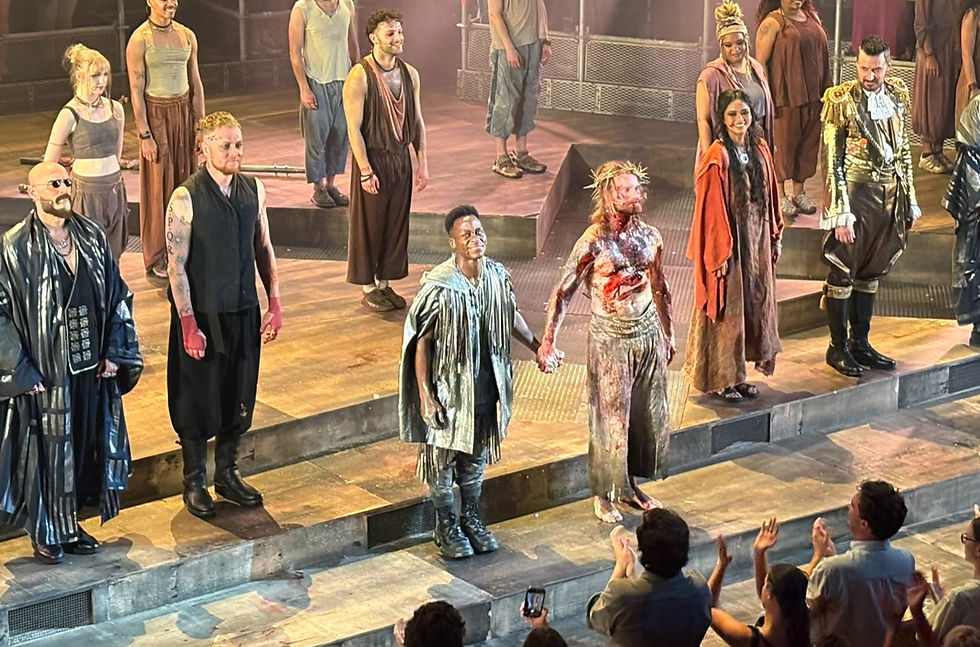
On the other hand, Tyrone Huntley dazzles as Judas. He carries the brunt of the material—vocal and dramatic—and his vocals are raw and emotionally charged, while retaining the rock quality required for the role. Kicking off the production with “Heaven on Their Minds,” he immediately announces his presence and never relinquishes it, delivering a vocal performance for the ages while capturing Judas’ darkness, conflict, and humanity.
Desmonda Cathabel’s Mary Magdalene is the only principal character who fell victim to the show’s constant energy level. Mary is the calming presence in Jesus’ life, nowhere more evident than her early number “Everything’s Alright.” Though it ends energetically, the song needed to begin in a softer place than it did, so it had nowhere to grow. Nonetheless, Cathabel’s vocals are stunning. Her slightly folk-like timbre lends itself well to this material and she brings a real emotional depth to her character.
However, the standout performance of the evening comes from none other than David Thaxton as Pontius Pilate. His voice carries such gravitas on either end of his register, and his commanding stage presence heightened the tension of the second act tenfold. It was phenomenal to see him onstage again following his triumphant run in Sunset Blvd., and he is truly giving one of the finest performances currently in the West End.

Supporting the leading quartet are some brilliant performers in their own right. Bob Harms lends his seemingly bottomless bass to the role of Caiaphas–the high priest–instilling the perfect amount of darkness. The ensemble portraying the high priests also utilize my favorite prop of the show: staffs that, when flipped over, become microphones for the rock-propelled numbers. They fit perfectly with the show’s overall aesthetic and are incredibly clever. In the true definition of “princess track,” a handful of celebrities are sharing the role of King Herod and his one song this summer. Richard Armitage was fantastic, adding the perfect amount of camp to this absolutely ridiculous number that is a huge stylistic departure from the rest of the show.
Finally, there is one more character in this show: the audience… or at least, there ought to have been. On the lower level of Tom Scutt’s scaffolding set, a handful of audience members are invited to stand onstage for the duration of the show. Initially, this seemed like a fantastic concept, similar to the fervent crowd on Argyle Street for “Don’t Cry For Me Argentina” last year. However, from what I saw, the cast barely acknowledged the audience, rendering their presence largely superfluous and distracting. It was a huge missed opportunity, and could have led to a fascinating perspective on Jesus’ supporters and the general frenzy around celebrities today.

Fortunately, there is one area of this production that leaves little to take issue with: the technical execution. Lee Curran’s lighting both amplifies the show’s atmosphere and creates quieter moments for the emotionally driven scenes. He uses Scutt’s scaffolding to great effect, often backlighting the most dramatic moments and creating stunning visuals. Jesus Christ Superstar is a loud show by design, and this production does not shy away from that. Adam Fisher’s sound design balances the onstage orchestra and performers beautifully, delivering a crisp, clear mix to the house.
Overall, this production of Jesus Christ Superstar is an entertaining evening of theatre, delivering thrilling vocals, stellar musicianship, and inventive ideas. However, the production’s insistence on keeping the entire show at maximum intensity prevents it from ever reaching the dramatic demands of the story. It is impossible not to draw comparisons–aesthetic and directional–between last summer’s Evita, another concert-embracing Lloyd Webber-Rice rock opera. Yet Evita succeeded in finding stillness among the frenzy, making its spectacle all the more impactful—whereas Jesus Christ Superstar rarely allows itself that same restraint. In the end, Jesus Christ Superstar reminds us that even rock operas need moments of quiet to make the noise matter.
3.5/5 stars
2 hours, one interval
London Palladium (through September 5, 2026)
Theatre Royal Drury Lane (October 16, 2026 through January 9, 2027)


